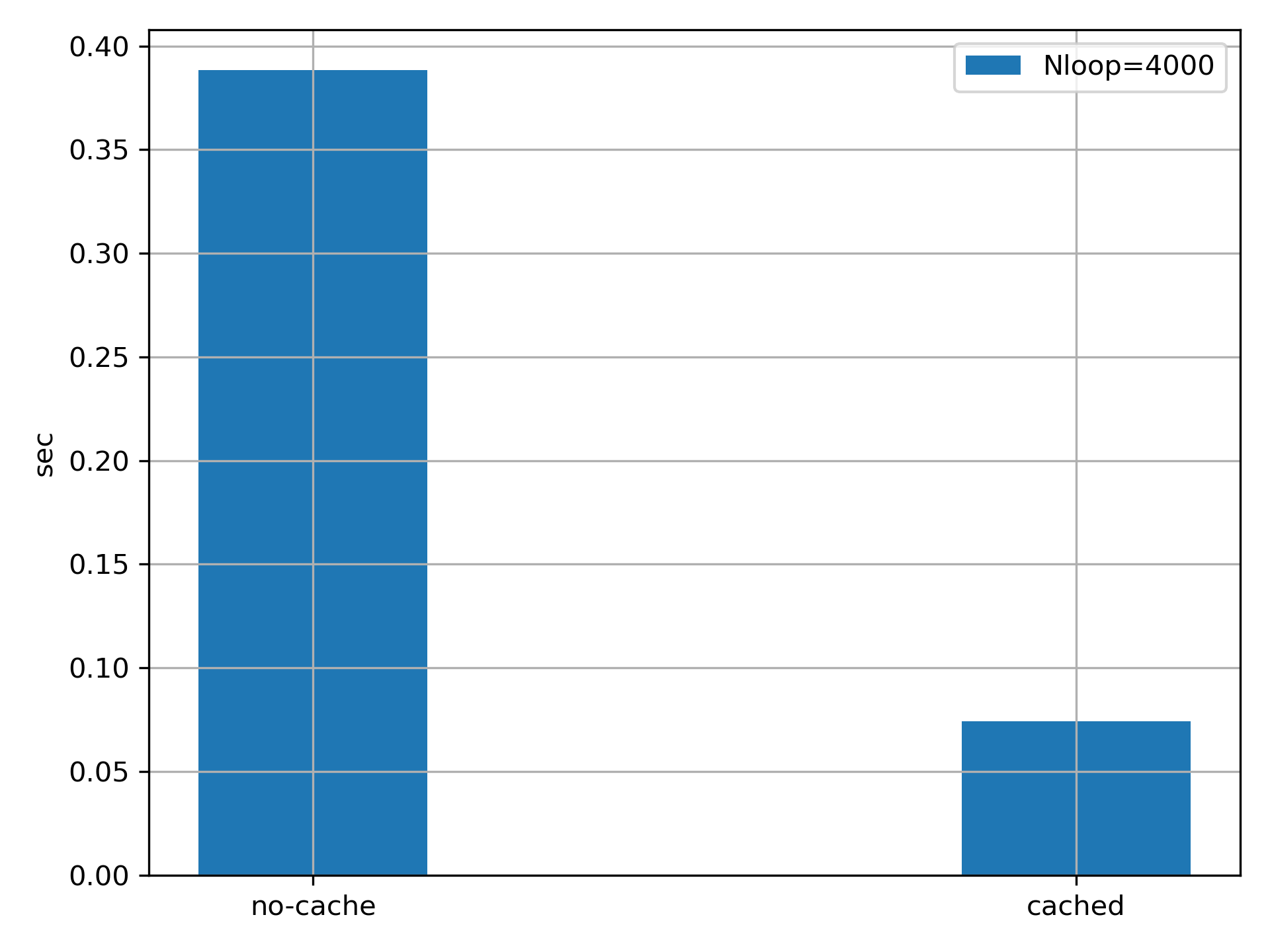
Tensordot with input cache
Starting from v0.6.4a, linalg::Tensordot provides an additional option cache for both input tensors. The feature provides user flexibility to minimize the redundant move of elements when the tensordot is repeatly called on two same Tensors.
To show how this makes difference, let’s consider a scenario where we contract two A and B Tensors N times:
In Python:
1import cytnx as cy
2A = cy.arange(24).reshape(2,2,2,3)
3B = A + 4
4
5for i in range(20):
6    C = cy.linalg.Tensordot(A,B,[0,2],[1,0])
In the above code, we see that Tensordot on A and B are repeatly evaluated where no change is made on A and B. Now, inside Tensordot, both Tensor A and B will be first contiguous-permuted to shapes with
which the data of A and B are then feed into Matmul to get the outcome. Specifically, for each Tensordot() call, it is equivalent to (psudo-code)
1#inside linalg.Tensordot(A,B,[0,2],[1,0]):
2
3tA = A.permute(1,3,0,2).contiguous() #move elements
4tB = B.permute(1,0,2,3).contiguous() #move elements
5
6call *gemm with tA's data and tB's data  ->tC
7
8permute tC to right shape -> output
We can clearly see the downside of this: every time Tensordot() is called, we have to move elements of A and B to the right place (highlight lines). Since A and B are not changed within the for loop, we can ask Tensordot to cache the input tensor(s) using the optional argument cacheL/R. That is to say, the first time Tensordot() is called, we directly move the elements within A and B themselves and memorize it. The next time it is called, we don’t have to move elements again.
In Python:
1import cytnx as cy
2A = cy.arange(24).reshape(2,2,2,3)
3B = A + 4
4
5for i in range(20):
6    C = cy.linalg.Tensordot(A,B,[0,2],[1,0],cacheL=True,cacheR=True)
Note
Here, we use the word “memorize”. Technically, we just move the internal data to it’s direct gemm place, and modify the meta data of Tensor to be the same as original input. Note that this will put the A and B in their non-contiguous status. In terms of user’s perspective point of view, there is no differece of using API than we used to do without cache.
The two input Tensors cannot have same_data()=True. This will be check inside Tensordot.
Tip
You can also choose to only cache either one of the tensor, for example, setting cacheL=True and cacheR=False will only cache A Tensor.
In the following we show the performance benchmark with the above code running with Nloop=4000 and average over 10 times of runs.